そのオリンパスのデジカメで撮ったアサガオ開花動画
いろんな連続写真で遊んでいこうとおもう。
wdtサンプル
_delay_msは電力の無駄なのでwdtでLEDをチカチカさせるサンプル。
// tiny2313V @ 1MHz
#include <avr/io.h>
#include <avr/interrupt.h>
#include <avr/sleep.h>
#include <avr/wdt.h>
#include <util/delay.h>

/*
volatile long timer = 0;
ISR(WDT_OVERFLOW_vect)
{
}
*/

EMPTY_INTERRUPT(WDT_OVERFLOW_vect);
int main(void)
{
  int i;

  // start WDT
  cli();
  wdt_reset();
  MCUSR &= ~(1<<WDRF);          // 「WDTリセットされた」フラグクリア
  WDTCSR |= (1<<WDCE)|(1<<WDE); // wdt変更前処理
#define _WDT_15MS  ((0<<WDP3)|(0<<WDP2)|(0<<WDP1)|(0<<WDP0))
#define _WDT_30MS  ((0<<WDP3)|(0<<WDP2)|(0<<WDP1)|(1<<WDP0))
#define _WDT_60MS  ((0<<WDP3)|(0<<WDP2)|(1<<WDP1)|(0<<WDP0))
#define _WDT_120MS ((0<<WDP3)|(0<<WDP2)|(1<<WDP1)|(1<<WDP0))
#define _WDT_250MS ((0<<WDP3)|(1<<WDP2)|(0<<WDP1)|(0<<WDP0))
#define _WDT_500MS ((0<<WDP3)|(1<<WDP2)|(0<<WDP1)|(1<<WDP0))
#define _WDT_1S    ((0<<WDP3)|(1<<WDP2)|(1<<WDP1)|(0<<WDP0))
#define _WDT_2S    ((0<<WDP3)|(1<<WDP2)|(1<<WDP1)|(1<<WDP0))
#define _WDT_4S    ((1<<WDP3)|(0<<WDP2)|(0<<WDP1)|(0<<WDP0))
#define _WDT_8S    ((1<<WDP3)|(0<<WDP2)|(0<<WDP1)|(1<<WDP0))
  WDTCSR  = (1<<WDIE)|(0<<WDE)|_WDT_1S;
                                // wdt設定 reset=0, interrupt=1, 1sec.
  sei();

  DDRB  = 0b00001111;
  for(i=0;i<5;i++){
    PORTB = 0b00001111;
    _delay_ms(100);
    PORTB = 0b00000000;
    _delay_ms(100);
  }

  set_sleep_mode(SLEEP_MODE_PWR_DOWN);
  for(;;){
    for(i=0; i<8; i++){ // 0.02mA
      PORTB = i % 16;
      sleep_mode();
    }
    for(i=8; i<16; i++){ // 5.5mA-6.0mA
      PORTB = i % 16;
      _delay_ms(1000);
    }
  }
}
参考: http://avrwiki.jpn.ph/wiki.cgi?page=Getting+Started+Notes+%2D+SLEEP
オリンパスのデジカメのリモコンをAVRで作った
オリンパスのリモコンRM-1
のコードを5分おきに送信してシャッターを切ります。

材料
- Atmel AVR Tiny2313V
- 赤外線LEDが1個
- (パスコン)
- 単三電池2本&電池ボックス
// Olympus Remocon

#include <avr/io.h>
#include <avr/interrupt.h>
#include <avr/sleep.h>
#include <avr/wdt.h>
#include <util/delay.h>
#define nop() __asm__ __volatile__ ("nop")

void send_ir(int us, char on)
{
  // 38KHz 1sec=1000ms=1000000us => 38000
  // 1000000/38000 = 26.3157895us on/off 13.1578947us
  // 1MHz => 1sec => 1000000 => 1op=1us
  for(; 0<=us; us-=26){
    PORTB = on ? 0b00000011 : 0b00000000;
    nop(); nop(); nop(); nop(); nop();
    nop(); nop(); nop(); nop(); nop();

    // ON 12 / OFF 1.. 6
    // ON 10 /     3.. 8
    // ON  5 /     8..13

    PORTB = 0b00000000;
    nop(); nop(); nop(); nop(); nop();
  }
}

void send_data(char* data, int bits)
{
  int i;
  int lead_high_len = 9000;
  int lead_low_len  = 4500;
  int data_high_len =  560;
  int data_low0_len =  560;
  int data_low1_len = 1690;
  int stop_high_len =  560;

  DDRB  = 0b00000011;
  send_ir(lead_high_len, 1);
  send_ir(lead_low_len,  0);
  for(i=0; i<bits; i++){
    int on = data[i/8] & (1<<(7-i%8));
    send_ir(data_high_len, 1);
    send_ir(on ? data_low1_len : data_low0_len, 0);
  }
  send_ir(stop_high_len, 1);
  _delay_ms(1000);
}

EMPTY_INTERRUPT(WDT_OVERFLOW_vect);

void init_wdt_interrupt(int interval)
{
  cli();
  wdt_reset();
  MCUSR &= ~(1<<WDRF);          // 「WDTリセットされた」フラグクリア
  WDTCSR |= (1<<WDCE)|(1<<WDE); // wdt変更前処理
#define _WDT_15MS  ((0<<WDP3)|(0<<WDP2)|(0<<WDP1)|(0<<WDP0))
#define _WDT_30MS  ((0<<WDP3)|(0<<WDP2)|(0<<WDP1)|(1<<WDP0))
#define _WDT_60MS  ((0<<WDP3)|(0<<WDP2)|(1<<WDP1)|(0<<WDP0))
#define _WDT_120MS ((0<<WDP3)|(0<<WDP2)|(1<<WDP1)|(1<<WDP0))
#define _WDT_250MS ((0<<WDP3)|(1<<WDP2)|(0<<WDP1)|(0<<WDP0))
#define _WDT_500MS ((0<<WDP3)|(1<<WDP2)|(0<<WDP1)|(1<<WDP0))
#define _WDT_1S    ((0<<WDP3)|(1<<WDP2)|(1<<WDP1)|(0<<WDP0))
#define _WDT_2S    ((0<<WDP3)|(1<<WDP2)|(1<<WDP1)|(1<<WDP0))
#define _WDT_4S    ((1<<WDP3)|(0<<WDP2)|(0<<WDP1)|(0<<WDP0))
#define _WDT_8S    ((1<<WDP3)|(0<<WDP2)|(0<<WDP1)|(1<<WDP0))
  WDTCSR = (1<<WDIE)|(0<<WDE)|interval;
                                // wdt設定 reset=0, interrupt=1
  sei();
}

void main_olympus(void)
{
  char shutter[] = {0b01100001, 0b11011100, 0b10000000, 0b01111111};
  char wide[]    = {0b01100001, 0b11011100, 0b01000000, 0b10111111};
  char tele[]    = {0b01100001, 0b11011100, 0b11000000, 0b00111111};
  char minus[]   = {0b01100001, 0b11011100, 0b00100000, 0b11011111};
  char plus[]    = {0b01100001, 0b11011100, 0b10100000, 0b01011111};
  int  i, t;

  init_wdt_interrupt(_WDT_1S);
  set_sleep_mode(SLEEP_MODE_PWR_DOWN);
  for(;;){
    send_data(shutter, 32);
    send_data(shutter, 32);
    send_data(shutter, 32);
    for(i=0; i<57; i++){ sleep_mode(); } // 57sec..

    for(t=0; t<4; t++){ // 1min x 4.
      send_data(wide, 32);
      for(i=0; i<59; i++){ sleep_mode(); }
    }
  }
}

int main(void)
{
  main_olympus();
}
秋月通販で買えるAVRの比較
| tiny2313V | mega88 | mega164P | mega644P | ||
|---|---|---|---|---|---|
| 秋月価格 | 100 | 250 | 400 | 550 | |
| ピン数 | 20 | 28 | 40 | 40 | |
| フラッシュメモリ | 2k | 8k | 16k | 64k | |
| EEPROM | 128 | 512 | 512 | 2048(2k) | |
| SRAM | 128 | 1024(1k) | 1024(1k) | 4096(4k) | |
| タイマー | 8*1,16*1 | 8*2,16*1 | 8*2,16*1 | ← | |
| RTC | - | ○ | ○ | ← | |
| PWM | 4 | 6 | 6 | ← | |
| ADC | - | 6 | 8 | ← | |
| AC | 1 | 8 | 8 | ← | |
| 2線シリアル | USI | TWI | TWI | ← | |
| USART | 1 | 1 | 2 | ← | |
| SPI | USI | SPI | SPI | ← |
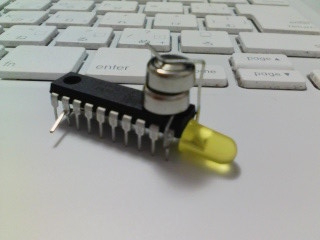
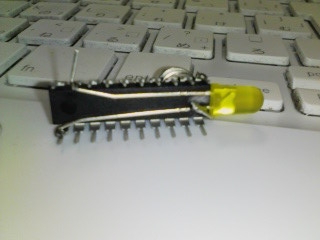
AVRホタル
暗いところに持っていくと点滅します。
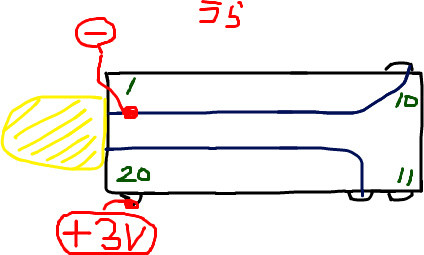
部品はtiny2313とLEDを1個ずつ。
LEDを光センサーとして使っています。

// AVR Hotaru

#include <avr/io.h>
//#include <avr/interrupt.h>
#include <util/delay.h>
#define nop() __asm__ __volatile__ ("nop")


#define SERIAL_DEBUG 0
#if SERIAL_DEBUG
  #define BAUD 2400
//#define SET_PORT(PORT, MASK, VALUE) PORT = (VALUE & MASK)|((~MASK) & PORT)
  void usart_init(void)
  {
    #define _UBRR (F_CPU/16/BAUD-1)
    UBRRH = _UBRR>>8;
    UBRRL = _UBRR;
    UCSRB = 0b00011000;
    UCSRC = 0b00000110;
  }
#endif

#define LED_DEBUG 1

int main(void)
{
  char ac0;
  int count    = 0;
  int on_count = 0;
  int on_rate  = 0;
  int i,j,k;
  int bright   = 0;
  int led_on   = 1;

#if SERIAL_DEBUG
  usart_init();
#endif

#if LED_DEBUG
  DDRD  = 0b01111100;
  PORTD = 0b00000000;
#endif

  for(;;){
    // 参考) http://elm-chan.org/junk/leddet/report.html
    // LEDポートに短時間"L"レベルを出力して接合容量Cjや浮遊容量Csを放電する。
    DDRB  = 0b00000001;
    PORTB = 0b00000000;
    _delay_ms(1);

    // LEDポートを入力に設定する→光電流により容量が充電され、入力電圧が直線的に上昇してくる。
    DDRB  = 0b00000000;
    PORTB = 0b00000000;

    // 4ms待ってから入射有りか判断
    _delay_ms(4);
    ac0 = ACSR & 0b00100000;
    if(ac0){
      on_count++;
    }
    count++;
    if(50<=count){
      on_rate  = 100*on_count/count; // 50サンプル取って平均
      count    = 0;
      on_count = 0;
    }

#if SERIAL_DEBUG
    while(!(UCSRA & 0b00100000));
    UDR = ac0 ? '*' : '.';
#endif

#if LED_DEBUG
    {
      unsigned char d = 0;
      if(on_rate<45){ d |= (1<<2); }
      if(on_rate<40){ d |= (1<<3); }
      if(on_rate<35){ d |= (1<<4); }
      if(on_rate<30){ d |= (1<<5); }
      if(on_rate<25){ d |= (1<<6); }
      PORTD = d;
    }
#endif

    DDRB  = 0b00000001;
    if(0){
      // 閾値でON/OFF
      if(on_rate<20){
        PORTB = 0b00000001;
      }else{
        PORTB = 0b00000000;
      }
      _delay_ms(30);
    }else{
      // 明るさ 0-100,100-0 のこぎり型に明滅
      int b;

      bright++;
      b = bright;
      if(100<bright){
        b = 200-bright;
        if(200<bright){
          bright = 0;
          led_on = (on_rate<20);
        }
      }

      //b = 100-on_rate;
      for(j=0; j<10; j++){
        if(led_on){
          PORTB = 0b00000001;
        }
        for(i=0; i<b; i++){
          _delay_ms(0.01);
        }

        PORTB = 0b00000000;
        for(i=0; i<100-b; i++){
          _delay_ms(0.01);
        }
      }
    }
  }
}
MacにAVR開発環境をつくった
http://www.obdev.at/products/avrmacpack/index.html
No.19 入門用AVR-ISPライター
http://homepage2.nifty.com/denshiken/AVW019.html
用の設定。
# Name: Makefile
# Author: <insert your name here>
# Copyright: <insert your copyright message here>
# License: <insert your license reference here>

# This is a prototype Makefile. Modify it according to your needs.
# You should at least check the settings for
# DEVICE ....... The AVR device you compile for
# CLOCK ........ Target AVR clock rate in Hertz
# OBJECTS ...... The object files created from your source files. This list is
#                usually the same as the list of source files with suffix ".o".
# PROGRAMMER ... Options to avrdude which define the hardware you use for
#                uploading to the AVR and the interface where this hardware
#                is connected.
# FUSES ........ Parameters for avrdude to flash the fuses appropriately.

DEVICE     = attiny2313
CLOCK      = 1000000
PROGRAMMER = -c avrispv2 -P /dev/tty.usbserial
OBJECTS    = main.o
FUSES      = -U hfuse:w:0xDF:m -U lfuse:w:0x64:m
# ATTiny2313 fuse bits (fuse bits for other devices are different!):
# WinAVR Extend:0xFF HIGH:0xDF LOW:0x64
# Example for 8 MHz internal oscillator
# Fuse high byte:
# 0xDF = 1 1 0 1   1 1 1 1 <-- 0RSTDISBL  (default:1) if set to 0, RESET pin is disabled
#        ^ ^ ^ ^   ^ ^ ^------ 1BODLEVEL0 (default:1) --
#        | | | |   | +-------- 2BODLEVEL1 (default:1) --
#        | | | |   +---------- 3BODLEVEL2 (default:1) BODLEVEL2-0 : 111 : disable low bat.
#        | | | +-------------- 4WDTON     (default:1) if set to 0, watchdog is always on
#        | | +---------------- 5SPIEN     (default:0) if set to 1, serial programming is disabled
#        | +------------------ 6EESAVE    (default:1) set to 0 to preserve EEPROM over chip erase
#        +-------------------- 7DWEN      (default:1) debug wire
#
# Fuse low byte:
# 0x64 = 0 1 1 0   0 1 0 0 <-- CKSEL0    (default:0) --
#        ^ ^ ^ ^   ^ ^ ^------ CKSEL1    (default:0) --
#        | | | |   | +-------- CKSEL2    (default:1) --
#        | | | |   +---------- CKSEL3    (default:0) CKSEL3-0 : 0100 : 8MHz RC
#        | | | +-------------- SUT0      (default:0) --
#        | | +---------------- SUT1      (default:1) SUT1-2   :   10 : 6*CK 14*CK+64ms
#        | +------------------ CKOUT     (default:1)
#        +-------------------- CKDIV8    (default:0)

# Tune the lines below only if you know what you are doing:

AVRDUDE = avrdude $(PROGRAMMER) -p $(DEVICE)
COMPILE = avr-gcc -Wall -Os -DF_CPU=$(CLOCK) -mmcu=$(DEVICE)

# symbolic targets:
all:    main.hex

.c.o:
        $(COMPILE) -c $< -o $@

.S.o:
        $(COMPILE) -x assembler-with-cpp -c $< -o $@
# "-x assembler-with-cpp" should not be necessary since this is the default
# file type for the .S (with capital S) extension. However, upper case
# characters are not always preserved on Windows. To ensure WinAVR
# compatibility define the file type manually.

.c.s:
        $(COMPILE) -S $< -o $@

flash:  all
        $(AVRDUDE) -U flash:w:main.hex:i

fuse:
        $(AVRDUDE) $(FUSES)

# Xcode uses the Makefile targets "", "clean" and "install"
install: flash fuse

# if you use a bootloader, change the command below appropriately:
load: all
        bootloadHID main.hex

clean:
        rm -f main.hex main.elf $(OBJECTS)

# file targets:
main.elf: $(OBJECTS)
        $(COMPILE) -o main.elf $(OBJECTS)

main.hex: main.elf
        rm -f main.hex
        avr-objcopy -j .text -j .data -O ihex main.elf main.hex
# If you have an EEPROM section, you must also create a hex file for the
# EEPROM and add it to the "flash" target.

# Targets for code debugging and analysis:
disasm: main.elf
        avr-objdump -d main.elf

cpp:
        $(COMPILE) -E main.c
直接使うときは↓
avrdude -v  -c avrispv2 -P /dev/tty.usbserial -p attiny2313 -U flash:w:ISP2313T.hex:i
avrdude -vv -c avrispv2 -p t2313 -P /dev/tty.usbserial
